First, make it testable. Then, make it real.
From a working sketch to a first useful release, without unnecessary features or unexamined assumptions. We create clickable prototypes, validate user journeys and build web and mobile MVPs.
NESOIA SOFTWARE works with ideas that deserve a proper conversation but still need clear boundaries. We separate a product’s central value from its wish list, make the future interface tangible before programming and define a sensible first release. A prototype should not pretend to be an established business. Its purpose is to answer a specific question honestly while the decision is still open to change. That makes early design a practical business tool, not decoration for a pitch.
Discuss a project ↗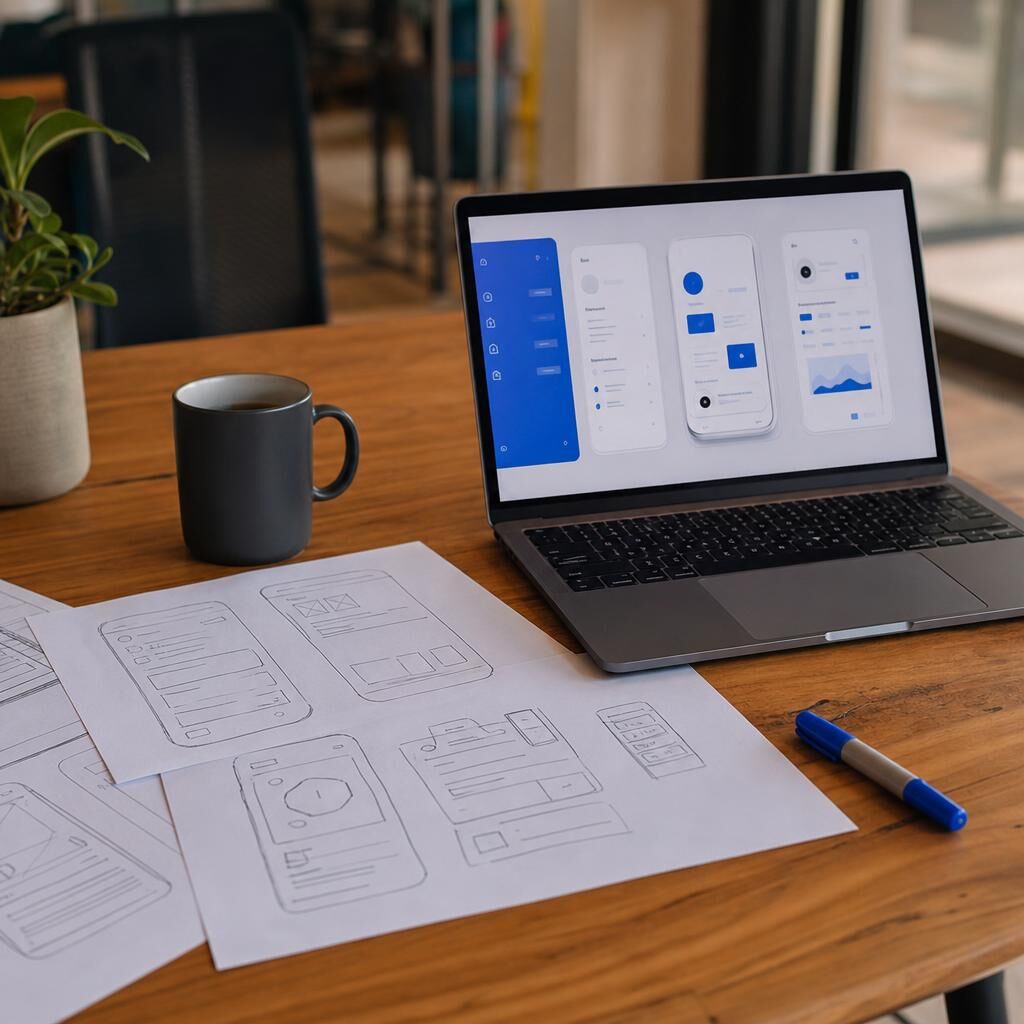 sketchdirection
Visual comparison of one AI illustration; not an example of a client project.
Start with the question, not the screens
Explore the detail ↗Behind an app idea there is usually an unresolved job. It needs a precise description: who experiences the problem, how they work around it now and why that is insufficient. A working conversation gathers context, known constraints and decisions already made. Assumptions do not carry equal risk, so we choose a question whose answer will genuinely influence the next step.
The result is a short product definition and a set of open questions, not a large document for its own sake. If the problem remains too broad, we narrow the audience or journey. This makes subsequent work easier to estimate and avoids spending a prototype budget demonstrating every possible feature at once.
- The intended audience, usage context and one desired outcome.
- Assumptions to investigate before the first version enters development.
- Work boundaries and criteria for a useful prototype.
Walk through the idea
Explore the detail ↗A clickable prototype connects screens into a sequence of actions. It lets you examine navigation, content and decision-making without building the whole system. Fidelity follows the question: simple blocks may be sufficient, while another journey needs realistic wording and a considered visual direction. Greater visual detail is not automatically more useful.
We identify what is simulated, including data, payments, server responses or complex interactions. A prototype does not establish that an integration is technically feasible and is not a working application. Reviews collect feedback on specific steps rather than a general expression of approval. We hand over a flow map and limitations so a later developer does not mistake demonstration behaviour for an implemented feature.
- A connected journey with agreed entry and completion points.
- Clearly identified simulations, omitted states and next-iteration questions.
- A working design file and an explanation of its structure.
Look for behaviour, not just approval
Explore the detail ↗Validation should answer a concrete question: can someone find the right path, understand the consequence of an action and continue without assistance? We prepare tasks that do not reveal the expected answer and agree which observations will influence a decision. Participant sourcing and the handling of research materials are settled before sessions. A small set of conversations is not presented as statistical proof of demand.
We record difficulties, their context and plausible alternative explanations. Changes are then grouped by their effect on the main journey. Some problems need clearer words; others require different logic. Findings should enable a choice rather than create an impression of an infallible idea. Validation reduces uncertainty but cannot guarantee commercial success.
- A validation plan with questions, tasks and an agreed participation format.
- Observed behaviour separated from interpretation and change recommendations.
- Questions worth checking in the next prototype iteration.
Minimum does not mean unfinished
Explore the detail ↗An MVP should complete a useful journey for a defined audience. We reduce the number of capabilities rather than removing error handling, clear messages or basic access boundaries. Together we decide what the system does, what temporarily remains manual and how the team will handle the result. That separates a first product release from an attractive demonstration.
Web or mobile is chosen for the usage context, not simply the desire to appear in an app store. We describe backend, external service and content dependencies. A critical technical assumption deserves a separate feasibility check. Working builds are reviewed through journeys, showing what is ready, which limitations remain and which requests are deliberately outside the current scope.
- Agreed first-version capabilities and explicit exclusions.
- Working web or mobile builds for reviewing the central journey.
- Documented manual operations and dependencies before a public release.
From design file to product context
Explore the detail ↗Preparing for publication changes what a design file needs to contain. Real wording, long names, empty lists, errors and permission explanations all matter. We agree a basic component system so each new screen does not invent new rules. A mobile release also needs store materials and the required product information planned separately.
We do not promise platform approval or invent legal policies in place of the responsible product owner. We help identify missing materials and who needs to prepare them. Handover should explain more than final pictures: component behaviour, alternative states and content rules are included. This reduces implementation guesswork and makes differences between the design intention and the working build easier to discuss.
- Components, states and content rules for the agreed screen set.
- A publication material checklist with responsibility for each item.
- Interface behaviour notes for implementation and acceptance.
Make the decisions visible
Explore the detail ↗Uncertainty at the beginning is normal. The risk lies in behaving as though it does not exist. After the first conversation we propose a reviewable next outcome: a journey map, prototype, validation session or limited technical experiment. Scope, inputs and acceptance are agreed before work starts. New ideas are not silently mixed into the acceptance of an already agreed task.
Reviews explain what changed and why. The client provides context, wording and decisions through an agreed process. If a significant dependency emerges, we revisit the plan openly. This rhythm protects momentum without pretending that every change can be absorbed invisibly into the same cost and schedule. A clear record of decisions is part of the working material.
- One understandable outcome for each agreed piece of work.
- A written record of decisions, open questions and review actions.
- Visible effects of new requirements on scope and delivery planning.
Working material, not a sealed box
Explore the detail ↗A prototype and an MVP may have different teams taking the next step. We therefore preserve file structure, journey names and the reasoning behind important decisions. For design, that means flow maps, components and known gaps. For software, it means repositories, run instructions and configuration within the agreed scope. Ownership and transfer arrangements are defined in the engagement.
We also explain what was not tested. Demonstration data should not quietly enter production, and a manual workaround should not look like an automatic capability. If another team needs a handover conversation, we agree its format. A good handover allows precise questions instead of forcing the next developer to reconstruct the product intention from screenshots alone.
- Organised source material with structure and dependency notes.
- A list of untested assumptions, manual steps and known limitations.
- An agreed handover format for the client or the next team.
Develop what you have learned
Explore the detail ↗After the first release, return to the original questions. Has the journey changed, which difficulties recur and what does the team still handle manually? We help organise these signals without inventing success metrics. Analytics requires separately agreed events, legal considerations and implementation; it is not added automatically.
The next step need not be another major feature. Clearer wording, removing an unnecessary action or revisiting positioning may be more valuable. Support and new development have different boundaries and are agreed separately. We discuss work during Europe/Kyiv office hours without implying round-the-clock cover or guaranteed growth. A product is allowed to change direction when observations justify it; continuing the original feature list is not an outcome in itself.
- Observations connected to specific user journeys rather than general impressions.
- Next-iteration priorities with a clear explanation of their intended value.
- Separate agreement for support, defect fixes and new development.
What should we make next?
A prototype is not always the right answer. Choose the uncertainty that most obstructs your next decision. This suggestion helps frame a brief rather than replacing a proper conversation.
Start with a problem definition and journey map. Detailed visual design could conceal rather than resolve the uncertainty.
A clickable prototype and agreed validation tasks can reveal behaviour before software development.
Define MVP boundaries, manual operations and technical dependencies. Development and handover can then be estimated.
A starting point for a conversation, not an automatic price or timeline estimate. Your selection is not stored.
A brief without the busywork
Tick the answers you have. An incomplete list does not prevent an enquiry; it identifies where the first working conversation should focus. Your choices remain on this page and are not automatically submitted.
What question shall we work on?
Send the question you are working on, not a presentation of an imaginary perfect product. Who is the user? What is difficult for them today? What have you checked and what remains an assumption? If designs or a prototype exist, briefly describe their state.
Discuss a project ↗